Lessons as a Project Manager
The things I’ve learned in Applied IMC

A big part of my fall quarter this year (my last fall quarter as a student!) was learning the ins-and-outs of being a Project Manager. I’ve had experience leading teams before, but in much more informal settings, so I knew leading up to taking Applied IMC that it would be a challenge. I was excited, though- I had enjoyed my time as a content creator, and was even more stoked to get the chance to help others have that same sense of enjoyment and meaningful learning.
What have I learned?
The first thing I came to know as a PM was to trust the process. This was a big one- I was used to my groups I had led prior to Applied IMC not needing a guiding hand in nearly as extreme of a sense as my group needed (at least, initially). Most of the structure that was necessary for leading other groups like my high school drumline or my other study groups came from either the group itself, or was provided wholly by the teacher or professor in charge at the time. And my professor for Applied IMC, Dan Purdy, gave us structural scaffolding: the bones for things like Kanbans, Sprints, and other organizational tools to help deal with the somewhat daunting workload that comes with taking an IMC class at Western. These processes that we have taken so much time to learn have massive value that can add to almost any group’s success- so leaning into the structure was an important thing to prioritize. I did so, and I feel both myself and my group gained a huge advantage as a result!
By the way, this process we learned is centered around a fantastic thinking and organizational process called agile methodology. Atlassian, the creators of Trello as well as a bunch of other neat organizational tools and concepts, define agile methodology as “a project management approach that involves breaking the project into phases and emphasizes continuous collaboration and improvement“. I’d give it a look if you haven’t already- and if you’re already using this method, then stay AGILE!

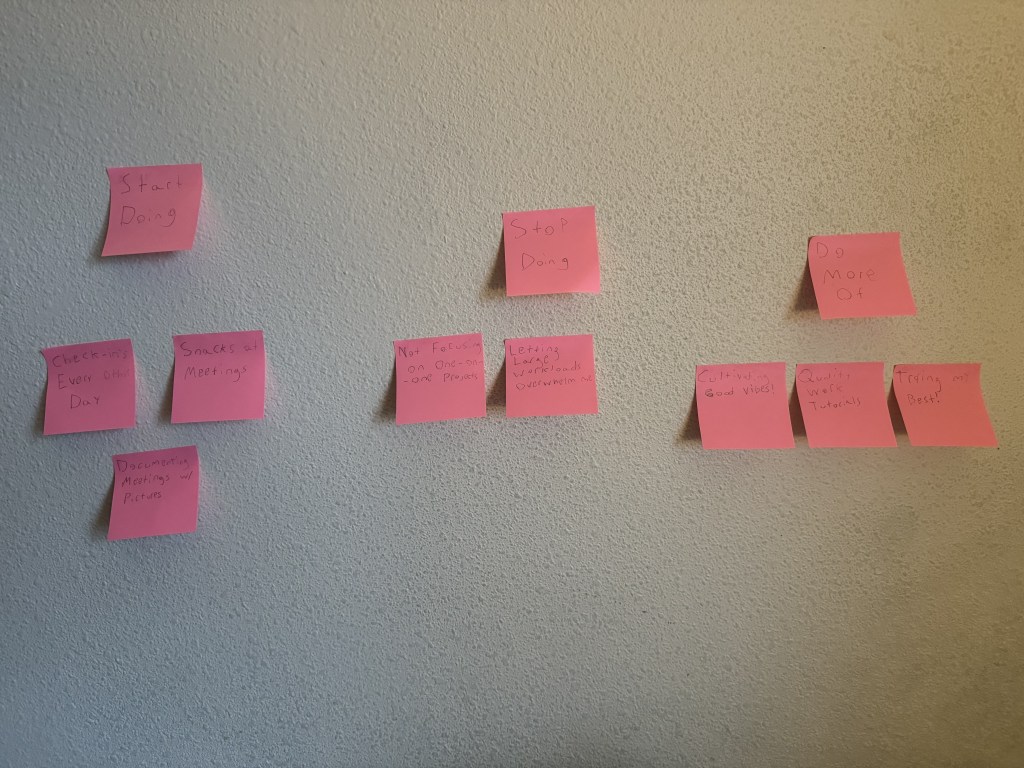
Another thing I learned was to review my processes and products. For example, we were asked to review our process of being a PM late in the quarter, which involves making sticky note cards oriented around three topics: Start Doing, Stop Doing, and Do More Of. I took time to reflect on what had happened this quarter, and was pleased with my insights I had for myself- for example, in Start Doing, I wanted to make sure that I knew to document things like meetings or project work times with photos. These can be used both for reference later, and as content for promotion!
In Stop Doing, I wanted to make sure that I stop letting large workloads overwhelm me. I have a tendency to panic- but I am getting better, it’s all about the process. I will never be done working on myself, but taking steps ahead in my process of doing so are always wins in my book.
In Do More Of, I took time to reflect on my accomplishments as a PM, and look toward the future in terms of what I can keep doing well as an individual- for example, one of my cards was simply “Cultivating Good Vibes”. I have taken pride in the level of friendliness, cooperation, and collaboration my group has achieved, and I believe this is because one of my strengths is making an environment in which people feel comfortable. I like to do that, and I think it works well for both improving the quality and optimization of work in a group, and also for just making everyone’s day better!
One final thing I have come to appreciate in not only IMC classes but over the course of all the classes that I have taken over the course of my later-stage marketing degree is that it is okay to fail, as long as you learn and get back up. I had my share of pitfalls in IMC, as well as every other class I’ve ever taken, and pretty much everything I’ve ever done. I, as well as everyone else on the planet, am no stranger to failure. The key, though, is to learn from your mistakes, and grow from them. This is especially apparent in IMC- the general idea is half the time you’re supposed to screw up whatever you’re doing, and you get help later in fixing it. You don’t remember things you’re supposed to just know very well- but you do remember things you learned as a result of having to correct them a hell of a lot more. This isn’t to say you shouldn’t try your best the first time around- why bother if you’re not trying? But I have come to accept my shortcomings as human, and learned to grow from them. I’ve written before about this- a lot. And I’ll keep writing about it, because I truly think of all the things I learned at my time at Western (and my time as an adult, frankly), this is by far the most important.

Overall, I had a blast in AIMC. I think it’s one of the most valuable classes I’ve ever taken, and I would recommend it to everyone who gets a chance to go through the IMC class pipeline. It can be tough, it can be a lot of work, but it will be fun, and teach you lessons about work, organization, motivation, and most importantly, it teaches you about yourself. Not many classes do that, and I am grateful for it. So thanks, Dan! I appreciate the opportunity, and I look forward to using the lessons I learned in the future to be a better marketer, manager, worker, and person.
 Matthew Edwards